

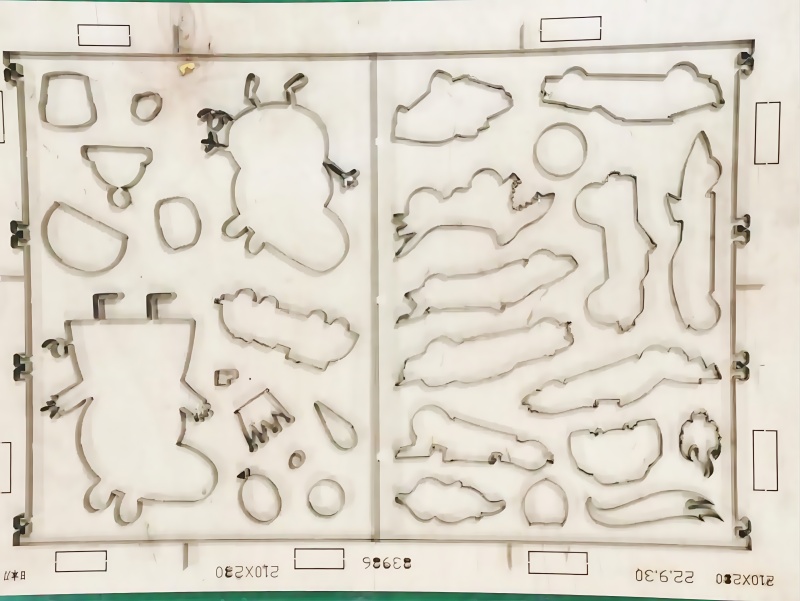


With its flexible customization, accurate cutting effect and efficient batch processing capacity, the application of knife mold in the arts and crafts field has become an important bridge between manual and industrial production, covering a wide range of subdivided scenes such as decorative ornaments, festival supplies and cultural and creative products, which not only retains the artistry of arts and crafts, but also improves production efficiency. The following is an introduction from specific application scenarios:
I. Processing of Paper Crafts
Paper handicrafts are one of the most widely used fields of knife dies because of their light materials and strong plasticity, and are especially suitable for mass production of works with complex patterns or three-dimensional structures;
Three-dimensional greeting cards and paper carvings: Folding petals, hollowed-out window scenes or fine patterns (such as figures and plant veins) in three-dimensional greeting cards can be precisely cut by laser or etching die, which can achieve millimeter-level line alignment and ensure the stability of the three-dimensional structure and symmetry of the pattern after folding. For example, for the "three-dimensional fireworks" and "hollow love" on holiday greeting cards, the knife mold can cut multiple layers of cardboard at one time to avoid pattern dislocation caused by manual cutting errors.
Paper decorative ornaments: paper bouquets, paper lanterns and geometric modeling pendants in beautiful shopping malls and home decoration. The knife mold can quickly cut unified petals, lampshade skeletons or polygonal components, and then form batch products through manual splicing, which not only ensures the consistency of modeling, but also reduces the manual cost.
Wenchuang paper products: special-shaped incision of notebook cover, hollowed-out pattern of bookmarks, indentation and cutting of postcards. The knife mold can be combined with the design of indentation line to realize the integrated processing of "cutting+indentation", which makes paper crafts both aesthetic and practical (such as foldable three-dimensional bookmarks).
Second, the production of fabric and leather crafts
Fabric and leather crafts pay attention to edge uniformity and pattern fineness, and the knife mold can effectively solve the problem of rough edges and irregularities in manual cutting;
Fabric decoration: pattern cutting of curtain ornaments, pillow decals and hand-made carpets. The knife mold can be adapted to different fabrics such as cotton cloth, flannel and linen, and accurately cut out cartoon images and plant patterns, especially for patterns that need to be repeated (such as symmetrical patterns on pillows), so as to ensure that each cloth sample has the same size and is convenient for sewing and splicing.
Small pieces of leather: key chains, bookmarks, coasters, or decorative leather pendants (such as animal shapes and letter pendants) in handmade leather. The knife mold can cut materials such as cowhide and PU leather to achieve smooth and burr-free edges, while avoiding leather stretching deformation caused by manual cutting, and enhancing the exquisiteness of finished products.
Festive fabric supplies: cloth stickers for the Spring Festival and fabric pendants for Christmas. The knife mold can combine multi-layer fabric cutting (such as fabric+interlining) to complete the molding of composite materials at one time, reducing the steps of manual layered cutting and improving production efficiency.
Three, composite materials and special-shaped crafts processing
For handicrafts with multi-layer materials or special materials, the "multi-layer synchronous cutting" ability of the knife die is particularly important:
Three-dimensional collage: a collage made of wood, cardboard, cloth, sponge and other multi-layer materials. According to the design requirements, the knife mold can cut the same pattern of different materials at one time (like the wooden base, paper petals and sponge filling layer of a flower) to ensure the accurate alignment of each layer, and the three-dimensional effect is stronger after splicing.
Resin and glue-dropping crafts: the silicone lining of the glue-dropping mold and the base of the resin ornaments are cut (such as the irregular outline of the wooden base), and the knife mold can cut materials such as silicone sheets and thin boards, providing an accurate "container" or supporting structure for the glue-dropping molding and ensuring the uniform shape of the finished product.
Metal wire and sheet arts and crafts: small metal decoration (such as wrought iron window stickers and copper bookmark), and knife die (especially etching knife die or laser knife die) can cut thin metal sheet to realize fine hollow patterns (such as traditional patterns and calligraphy fonts), which is more efficient than manual engraving and suitable for mass production.
Fourth, festivals and mass production of folk arts and crafts
Traditional festival crafts often need short-term mass production, and the high efficiency of the knife mold has obvious advantages in such scenes:
Mid-Autumn Lantern and Spring Festival Ornaments: Bamboo-wrapped paper for lanterns, paper-cut window grilles for the Spring Festival, and zodiac ornaments. The knife mold can quickly cut unified folk patterns (such as blessing characters, zodiac images and auspicious clouds) to meet the mass demand during festivals, while retaining the cultural charm of traditional patterns.
Wedding crafts: the special-shaped envelope of wedding invitation, the hollow design of wedding candy box, the flower-drawing paper-cutting of wedding room decoration, and the knife mold can combine the processes of bronzing and embossing to realize the integrated processing of "cutting+decoration", making wedding supplies both exquisite and ceremonial.
Core Value of Knife Mould in Arts and Crafts Field
Balance artistry and mass production: not only restore the designer's creative details (such as complex hollowing out and irregular outline), but also realize mass production, and solve the problems of low efficiency and poor consistency of manual production.
Adapting to multiple materials: From paper and cloth to leather and wood chips, the cutter die can ensure the best cutting effect of different materials by adjusting the blade material (for example, rubber cutter die is suitable for soft materials and steel cutter die is suitable for hard materials).
Lower the threshold of creation: For complex patterns, the knife mold can transform the design into a standardized cutting tool, so that small and medium-sized workshops can also produce handicrafts comparable to hand-made fine products, and promote the scale of creativity.
In a word, the knife mold provides key technical support for handicrafts from "single hand-made" to "mass production", which not only protects the artistic details of handicrafts, but also improves production efficiency, and becomes an important tool to connect creativity and market in the cultural and creative industries.

Add:No. 300 Zhujiawan Road, Zhoushi Town, Kunshan City, Suzhou, Jiangsu Province


