

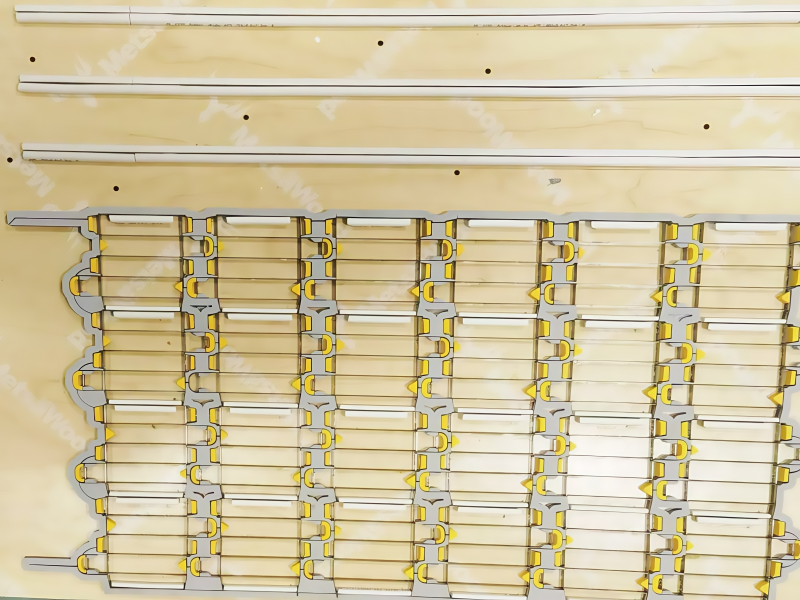


Introduction to the application of knife die in packaging and printing industry
As the core tool of the post-processing link in packaging and printing industry, knife die plays an irreplaceable role in the molding process of various packaging products with its efficient and accurate cutting ability. From food and medical packaging to gift boxes and e-commerce express boxes, the application of knife mold runs through many sub-scenes of packaging production, which directly affects the appearance quality and production efficiency of products.
1. Paper packaging processing: shaping diverse structures and shapes.
Paper packaging is one of the most widely used fields of knife dies, covering cartons, cartons, paper bags and other forms:
Folding carton forming: in the production of folding cartons such as cosmetic boxes, health care boxes and food gift boxes, the knife die is used to cut the outline, indentation lines and window structure of cardboard. For example, the special-shaped edge (such as arc and wave) and precise buckling design of the carton can be realized by customizing the knife die, so as to ensure the stable structure and tight splicing after folding.
Corrugated box processing: for corrugated boxes such as express boxes and household appliances packaging, the knife die is used to cut the outline of the unfolded drawing of the box and press the folding line. Heavy-duty die can meet the cutting requirements of 3-5 layers of corrugated paper, ensure the smooth edges of cartons and improve the stacking load-bearing performance.
Special paper art packaging: in high-end gift packaging, the knife mold can cooperate with bronzing, UV and other processes to realize complex modeling such as hollowing out and three-dimensional relief. For example, the art paper is precisely cut by a laser knife die to create a window opening design with strong light transmission and delicate patterns, and enhance the visual impact of packaging.
Second, plastic packaging and processing: meet the requirements of sealing and abnormity.
Plastic packaging is widely used in food, daily chemical and other fields because of its moisture-proof and durability. In the processing of such products, the die focuses on sealing edge cutting and special-shaped forming;
Cutting soft plastic packaging: For plastic bags and composite film packaging bags (such as snack bags and sauce bags), the knife die is used to cut the outline of the bag body and the easy-to-tear mouth. By heating the knife die, the integration of heat sealing edge and cutting can be realized, which ensures that the edge of the packaging bag is sealed tightly, and at the same time, the accurate cutting of the easy tear opening is convenient for consumers to open.
Blister/blister packaging molding: In the blister packaging of pharmaceutical tablets and hardware parts, the knife die is used to cut the composite structure of blister tray and cardboard. For special-shaped plastic products (such as multi-grid tablet holders), the knife die can accurately match the contour of each groove to avoid the product falling off caused by cutting deviation.
Plastic box processing: For transparent plastic boxes made of PP and PET (such as pastry boxes and toy boxes), the knife mold is used to cut the splicing edge and fastening structure of the box body to ensure the flatness and tightness of the box body after assembly.
Third, the packaging of composite materials: to adapt to the precise cutting of multi-layer structures.
With the diversification of packaging materials, materials composed of paper, plastic, aluminum foil, etc. are gradually popularized, and the knife die needs to adapt to the cutting characteristics of multi-layer materials:
Composite film packaging: In the processing of the sealing cover of milk powder cans and coffee cans (made of aluminum foil+cardboard+plastic film), the knife die needs to cut multiple layers of materials at the same time to ensure that the edges are free from delamination and burr, and to ensure the sealing and moisture-proof of the packaging.
Environmentally-friendly packaging materials: For degradable materials (such as paper+PLA composite film), the knife die can avoid material tearing or deformation during cutting by optimizing the angle and pressure of the blade, thus helping the large-scale production of environmentally-friendly packaging.
Fourth, label and bill printing: realize fine cutting and die cutting.
In the packaging and printing of labels and bills, the die is used to finish the final shaping and cutting;
Self-adhesive label die-cutting: Self-adhesive products such as food labels, logistics sheets and commodity price tags are cut into specific shapes (such as round, oval and special-shaped logo) by a knife die, and the label is accurately separated from the backing paper, which is convenient for subsequent automatic labeling.
Anti-counterfeiting bill processing: in the anti-counterfeiting labels or bills of cigarettes, alcohol and luxury goods, the knife die can cut out anti-counterfeiting structures such as miniature characters and irregular hollowing, and cooperate with the printing process to improve the anti-counterfeiting performance of the products.
Core Value of Knife Die in Packaging and Printing Industry
Customized adaptation: patterns and structures can be accurately restored according to packaging design drawings, and flexible switching between small-batch personalized packaging and large-batch standardized production can be supported to meet the needs of brand owners for packaging differentiation.
Efficiency improvement: With the automatic die-cutting machine, the knife die can realize dozens to hundreds of continuous cuts per minute, which is more than 100 times higher than the traditional manual cutting efficiency, and meets the fast-paced production needs of the packaging industry.
Quality assurance: the cutting error of precision knife die (such as laser knife die) can be controlled within 0.05mm, so as to ensure the uniform size and smooth edge of packaged products and enhance consumers' first impression of products.
From basic packaging molding to high-end creative design, the knife die has become a key bridge for the packaging and printing industry to achieve "design landing" and "mass production" by cooperating with printing technology, which has promoted the development of packaging products in a more beautiful, practical and environmentally friendly direction.

Add:No. 300 Zhujiawan Road, Zhoushi Town, Kunshan City, Suzhou, Jiangsu Province


