

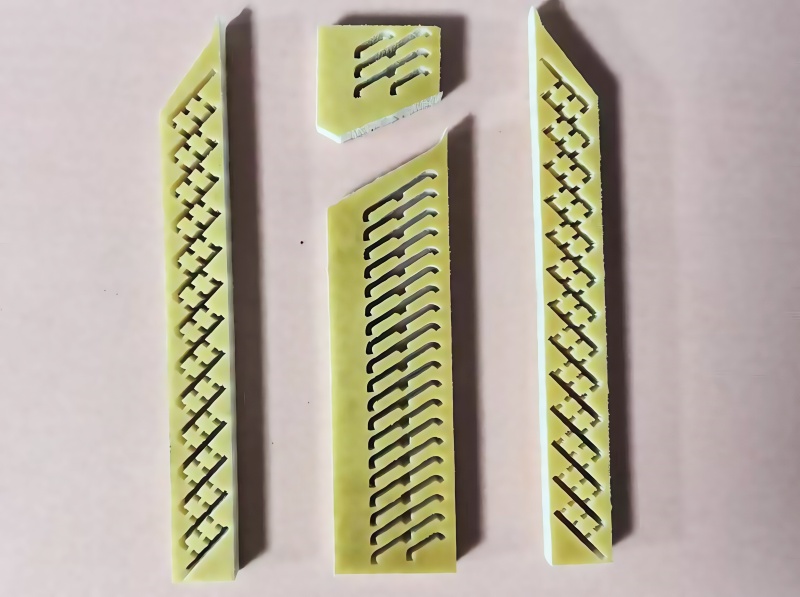


Knife die is a key tool to realize precision machining and ensure product quality in the electronic industry. It is widely used in the production of electronic components, terminal equipment and supporting materials. Its core value lies in meeting the strict requirements of the electronic industry for dimensional accuracy, consistency and efficiency through high-precision cutting and molding. The following is an introduction from specific application scenarios:
I. Processing of electronic components
Auxiliary processing of circuit board (PCB): In the post-processing of PCB, the die can be used to cut covering film, insulating sheet, shielding cover and other auxiliary materials. For example, the covering film of flexible PCB board needs to be accurately matched with the circuit, and the cutter die can realize non-deviation cutting through high-precision stamping to ensure that the covering film fits tightly and avoid signal interference.
Cutting of electronic connector fittings: Small fittings such as plastic insulating base and metal shrapnel of connectors are often cut or punched in batches by knife dies. The high stability of the cutter die can ensure that the dimension error of the fittings is controlled within ±0.01mm, which meets the precise matching requirements of connector insertion and removal.
Second, the terminal equipment structure production
Processing of mobile phone, computer and other shell accessories: the buffer foam, heat dissipation graphite sheet, dust screen, etc. in the mobile phone shell need to be cut into specific shapes through a knife die. For example, the dust-proof net around the camera of a mobile phone and the knife die can accurately cut the micropores and irregular edges, which not only ensures air permeability, but also fits the shell structure.
Treatment of materials around the display screen: In the backlight module of the display screen, multilayer film materials such as light guide plate, diffuser and brightness enhancement sheet need to be cut or die-cut by a knife die to ensure that the dimensions of each layer are completely matched, avoid light leakage or uneven light and shadow, and improve the display effect.
Three, electronic packaging and protective material processing
Anti-static packaging cutting: the packaging materials such as anti-static bags and trays of electronic components need to be customized according to the size of the components. The die can quickly cut the packaging structure that meets the specifications, while ensuring smooth edges and avoiding scratching the components due to raw edges of the materials.
Cushion protection material molding: EVA foam, pearl cotton and other cushioning materials used for electronic equipment transportation can be cut into specific grooves or shapes by knife die, which can accurately wrap the equipment and prevent vibration damage during transportation.
Fourth, flexible electronics and emerging fields
Material processing of flexible screens and wearable devices: flexible electronics's flexible circuits and sensor bonding layers of wearable devices are mostly made of thin and easy-to-deform materials (such as PI film and silica gel). The low-temperature cutting technology of the die can avoid the deformation of materials due to high temperature and ensure the cutting accuracy.
Processing of new energy electronic components: In the production of lithium batteries, the die can be used to cut the insulating rubber of electrode tabs and the sealing rubber pad of battery case, so as to ensure the insulating performance and sealing performance and reduce the potential safety hazard.
Core Advantages of Knife Mould in Electronic Industry
High accuracy: The electronic industry requires extremely high dimensional accuracy (usually ≤0.02mm). Precision cutter dies such as laser cutter dies and etching cutter dies can achieve micron-level cutting accuracy through digital design and processing, and meet the processing requirements of micro parts.
High efficiency: With automatic stamping equipment, the die can cut dozens or even hundreds of times per minute continuously, which greatly improves the mass production efficiency and adapts to the rapid iterative rhythm of the electronics industry.
Strong adaptability: The die structure can be customized for different materials (such as film, metal foil, plastic, foam, etc.) to solve the processing problems such as easy tearing and deformation of materials.
In a word, as the "invisible tailor" of the electronic industry, the knife die provides important support for the performance stability and production scale of electronic products through accurate and efficient cutting, and is an indispensable key tool for the electronic manufacturing industry.

Add:No. 300 Zhujiawan Road, Zhoushi Town, Kunshan City, Suzhou, Jiangsu Province


